
For years, Customer Experience (CX) teams were built around a simple idea: understand how customers feel. Dashboards filled with sentiment scores, NPS trends, and keyword clouds became the standard. They gave organizations a sense of control—a way to “take the pulse” of the customer base. But in today’s environment, that approach is no longer enough. As budgets tighten and expectations rise, leadership is asking a different question. Not “How do customers feel?” but “What is the impact on the business—and what are we going to do about it?” This shift marks a fundamental turning point in CX. Insight alone is no longer valuable unless it leads directly to action.
The 250,000-Ticket Reality
Consider the reality many CX leaders are facing today. A typical mid-sized company may be managing more than 1,000 support tickets every week—adding up to nearly a quarter of a million interactions every year. At that scale, the challenge isn’t collecting feedback. There is more than enough data.
The real challenge is making sense of it quickly enough to drive meaningful change. Support teams find themselves stuck in a loop. Agents repeatedly answer the same questions. Managers try to identify patterns manually. Leadership receives reports that describe problems—but don’t clearly define solutions. When volume reaches this level, the goal is no longer visibility. It’s efficiency. And most importantly, speed.
Why Traditional CX Approaches Break Down
The tools that once defined CX were not built for this reality. Traditional platforms focus heavily on performance metrics for reporting. To identify the primary drivers of agent workload and customer friction, analysts traditionally organize feedback into categories, highlight trends, and produce visual summaries. But they still rely on manual effort to get there—manual tagging, keyword configuration, and interpretation.
Even when the data is accurate, the process is slow. By the time insights are identified, the opportunity to act on them has often passed. And even when patterns are clear, teams are left asking the same question: “What do we do next?” This is where the gap becomes critical. CX teams don’t lack insight—they lack a direct path from insight to action.
The Need for a “Quick Win”
In high-volume support environments, complexity is the enemy. Leaders are not looking for another tool that requires months of implementation or heavy technical integration. They are looking for something much simpler: a fast, practical way to reduce workload and improve outcomes. A “quick win.” That means: A solution that works without complex setup Immediate visibility into recurring issues In practice, this means instantly identifying the most common customer questions and turning them into FAQ content—eliminating repetitive tickets before they reach your support team.
From Raw Feedback to Prioritized Issues
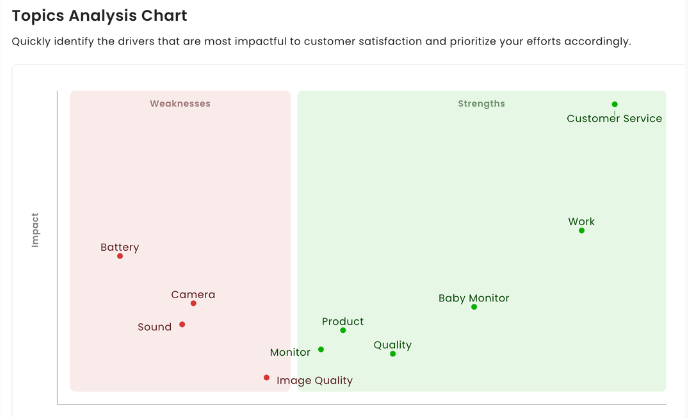
Instantly identify high-impact customer issues and prioritize what matters most to reduce support volume.
Clear actions that can be implemented quickly Tangible impact on support volume This is especially important when resources are limited and expectations are high. Every improvement needs to justify itself—not just in insight, but in measurable operational value.
The Shift to Agentic CX Analytics
What’s emerging now is a new category of CX capability—one that moves beyond analysis and into execution. This is where Agentic CX Analytics comes in. Instead of acting as a passive system that summarizes feedback, agentic systems function more like strategic analysts. They process large volumes of unstructured data automatically and identify recurring issues. Instead of manually tagging tickets, teams can instantly visualize the most frequent problems and how they evolve over time—making it easy to prioritize what needs attention first. and—most importantly—translate those issues into recommended actions.
From Insights to Actionable Strategy
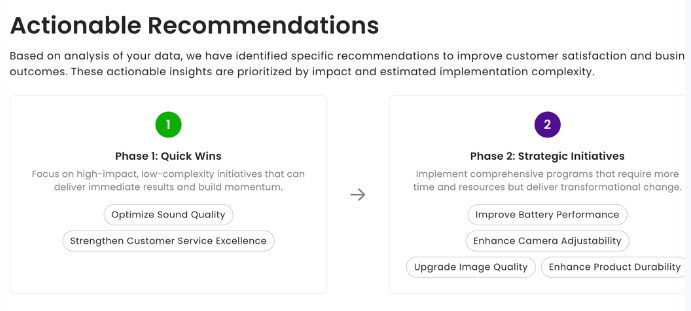
Automatically translate customer feedback into prioritized actions—from quick wins to strategic initiatives.
The difference is subtle, but powerful. Rather than telling you that customers are frustrated, the system identifies why they are frustrated, how often it occurs, and what specific action will reduce that friction. It removes the need for manual categorization entirely. What used to take hours of keyword configuration and data review now happens instantly, across hundreds of thousands of interactions. And instead of producing static dashboards, it produces direction.
Turning Insights Into Measurable Impact
The real value of this approach becomes clear when you look at how it affects day-to-day operations. Take a common scenario. A large percentage of incoming support tickets are tied to a specific issue—say, login errors or account access problems. In a traditional setup, identifying this pattern might take days of analysis. Even then, it may not lead to immediate action. With an agentic approach, that same issue is surfaced instantly, along with a clear recommendation: update the FAQ or help center content to address the problem directly. The result? A measurable reduction in incoming tickets—often significant enough to free up a meaningful portion of agent capacity. In some cases, addressing just a handful of recurring issues can deflect a substantial percentage of weekly support volume.
That means fewer repetitive inquiries, faster response times, and a more efficient support operation overall. This is where CX begins to shift from a reporting function to an operational driver.
The End Game for Modern CX Leaders
What CX leaders ultimately need is not more data—it’s clarity. They need to open a report and immediately understand: What are the most important issues? What impact are those issues having? What actions will deliver the fastest results? This is why automated executive reporting is becoming the new standard. Instead of presenting data to interpret, these reports present decisions that are ready to be made. They prioritize issues based on impact, outline recommended actions, and provide a clear path forward—all without requiring heavy integration or technical complexity. It’s a fundamentally different experience. One that aligns with how modern organizations operate: fast, focused, and outcome-driven.
CX Is No Longer a “Soft” Function
Perhaps the most important shift is how CX itself is perceived. For years, it was treated as a qualitative discipline—valuable, but difficult to tie directly to business performance. That perception is changing rapidly. Today, CX is expected to contribute to: Cost reduction, Operational efficiency, Customer retention Revenue growth And to do that, it must move beyond understanding sentiment and toward driving action.
The Question That Defines the Future of CX
As we move further into 2026, one thing is becoming clear. The organizations that succeed will not be the ones with the most data. They will be the ones who can act on it the fastest. Because at scale, the challenge is not knowing what customers are saying. It’s deciding what to do about it—and doing it quickly enough to make a difference. So the real question for CX leaders is no longer: “What are our customers feeling?” It’s this: What actions will eliminate 1,000 tickets next week?
Turn Your Support Data Into Action
If you’re managing high volumes of support tickets and looking for a faster, simpler way to reduce workload and improve customer experience, the approach you choose matters. The next generation of CX is not about better dashboards. It’s about clearer decisions and faster execution. Book a demo to see how you can turn your support data into a prioritized, actionable strategy—in minutes, not months.